
The EN ISO 11611 and EN ISO 11612 standards are European safety rules for protective work clothing. Both standards ensure that workwear protects workers from heat and burns, but they are built for different job environments.
The Main Difference
· EN ISO 11611 is specifically for welding and similar jobs. It protects against small flying sparks and electric shocks.
· EN ISO 11612 is a broader standard for general industrial heat and flames. It protects workers in factories, foundries, and chemical plants who face big heat hazards but are not necessarily welding.
Similarities (How They Are Alike)
· Flame Spread Protection: Both standards require the fabric to pass the Code A test (A1 or A2). This means if a spark or flame touches the clothes, the fabric will not keep burning or catch fire.
· Body Coverage: Both rules state that the uniform must fully cover the worker's body. This includes the neck, torso, arms to the wrists, and legs to the ankles.
· Fabric Strength: Both standards test the fabric to ensure it does not rip or tear easily during hard physical work.
· Shrinkage Limit: Both require that the clothes do not shrink much when washed, so the protective fit stays the same.
Differences (How They Are Different)
1. The Core Focus and Hazards
· EN 11611 (Welding): Focuses on small, constant splashes of liquid metal (spatter), brief flame contact, and radiation from the welding arc.
· EN 11612 (Industrial Heat): Focuses on large amounts of heat moving through the air (convective heat), intense invisible heat from hot surfaces (radiant heat), or large splashes of heavy liquid metal.
2. The Rating Scales (Classes vs. Codes)
· EN 11611 uses a simple Class 1 and Class 2 system:
o Class 1: For easy, low-risk welding with fewer sparks.
o Class 2: For heavy, high-risk welding with many sparks and high heat.
· EN 11612 uses a specific letter system from A to F, with numbers (1 to 3 or 4) to show the protection level for each specific hazard:
o Code B (1–3): Protection against convective heat (heat moving through air).
o Code C (1–4): Protection against radiant heat (infrared heat).
o Code D (1–3): Protection against liquid molten aluminum.
o Code E (1–3): Protection against liquid molten iron.
o Code F (1–3): Protection against contact heat (touching hot things).
3. Clothing Design Rules
· EN 11611 has very strict rules so sparks do not get trapped on the clothes. Pockets must have wide flaps, metal buttons must be covered, and there cannot be open folds.
· EN 11612 focuses more on heat movement. For example, the jacket must overlap the trousers by at least 20 cm while standing up so no heat can sneak inside the clothes.
4. Special Electrical Extra
· EN 11611 uniquely tests for electrical resistance. It makes sure the clothing protects the welder from accidental electric shocks up to 100 Volts.
· EN 11612 does not test for electrical insulation.
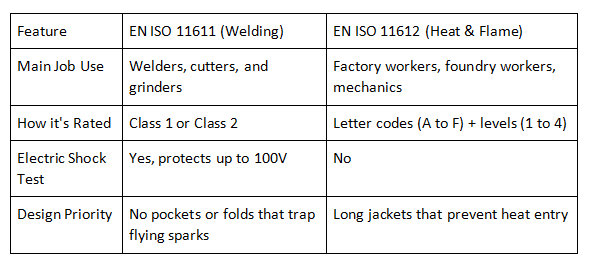
Summary Comparison Table
The EN ISO 11611 and EN ISO 11612 standards are European safety rules for protective work clothing. Both standards ensure that workwear protects workers from heat and burns, but they are built for different job environments.
The Main Difference
· EN ISO 11611 is specifically for welding and similar jobs. It protects against small flying sparks and electric shocks.
· EN ISO 11612 is a broader standard for general industrial heat and flames. It protects workers in factories, foundries, and chemical plants who face big heat hazards but are not necessarily welding.
Similarities (How They Are Alike)
· Flame Spread Protection: Both standards require the fabric to pass the Code A test (A1 or A2). This means if a spark or flame touches the clothes, the fabric will not keep burning or catch fire.
· Body Coverage: Both rules state that the uniform must fully cover the worker's body. This includes the neck, torso, arms to the wrists, and legs to the ankles.
· Fabric Strength: Both standards test the fabric to ensure it does not rip or tear easily during hard physical work.
· Shrinkage Limit: Both require that the clothes do not shrink much when washed, so the protective fit stays the same.
Differences (How They Are Different)
1. The Core Focus and Hazards
· EN 11611 (Welding): Focuses on small, constant splashes of liquid metal (spatter), brief flame contact, and radiation from the welding arc.
· EN 11612 (Industrial Heat): Focuses on large amounts of heat moving through the air (convective heat), intense invisible heat from hot surfaces (radiant heat), or large splashes of heavy liquid metal.
2. The Rating Scales (Classes vs. Codes)
· EN 11611 uses a simple Class 1 and Class 2 system:
o Class 1: For easy, low-risk welding with fewer sparks.
o Class 2: For heavy, high-risk welding with many sparks and high heat.
· EN 11612 uses a specific letter system from A to F, with numbers (1 to 3 or 4) to show the protection level for each specific hazard:
o Code B (1–3): Protection against convective heat (heat moving through air).
o Code C (1–4): Protection against radiant heat (infrared heat).
o Code D (1–3): Protection against liquid molten aluminum.
o Code E (1–3): Protection against liquid molten iron.
o Code F (1–3): Protection against contact heat (touching hot things).
3. Clothing Design Rules
· EN 11611 has very strict rules so sparks do not get trapped on the clothes. Pockets must have wide flaps, metal buttons must be covered, and there cannot be open folds.
· EN 11612 focuses more on heat movement. For example, the jacket must overlap the trousers by at least 20 cm while standing up so no heat can sneak inside the clothes.
4. Special Electrical Extra
· EN 11611 uniquely tests for electrical resistance. It makes sure the clothing protects the welder from accidental electric shocks up to 100 Volts.
· EN 11612 does not test for electrical insulation.
Summary Comparison Table
If you need help choosing or comparing a specific piece of workwear, please share what specific job tasks your workers do, what type of metals they work with, or the current rating labels on your gear.